

 English
 русский
 عربى
عربى

A set of design, research and development, production, sales, installation in one of the professional new decorative materials enterprises.
Content
- 1 The Real Cost Difference Between Wall Panels and Paint
- 2 What Makes Paint So Affordable
- 3 Understanding the True Cost of Decorative Wall Panels
- 4 Long-Term Cost: Where Panels Can Beat Paint
- 5 Room-by-Room Cost Breakdown: Which Makes More Sense
- 6 DIY vs. Professional Installation: How It Affects the Cost Gap
- 7 Visual Value and Perceived Quality: Does It Affect Resale?
- 8 Maintenance Costs Over Time: Paint Requires More Attention
- 9 How to Decide: A Practical Framework
- 10 Common Mistakes That Inflate the Cost of Both Options
- 11 Final Verdict: Which Is Actually Cheaper
If you're trying to decide between wall panels and paint for your next home renovation, here's the short answer: paint is almost always cheaper upfront, typically costing $1–$4 per square foot installed, while decorative wall panels range from $3 to $30+ per square foot depending on material. But the full picture is more nuanced — panels can last decades without repainting, which may make them more cost-effective over time. This article breaks down every cost factor so you can make a genuinely informed decision.
The Real Cost Difference Between Wall Panels and Paint
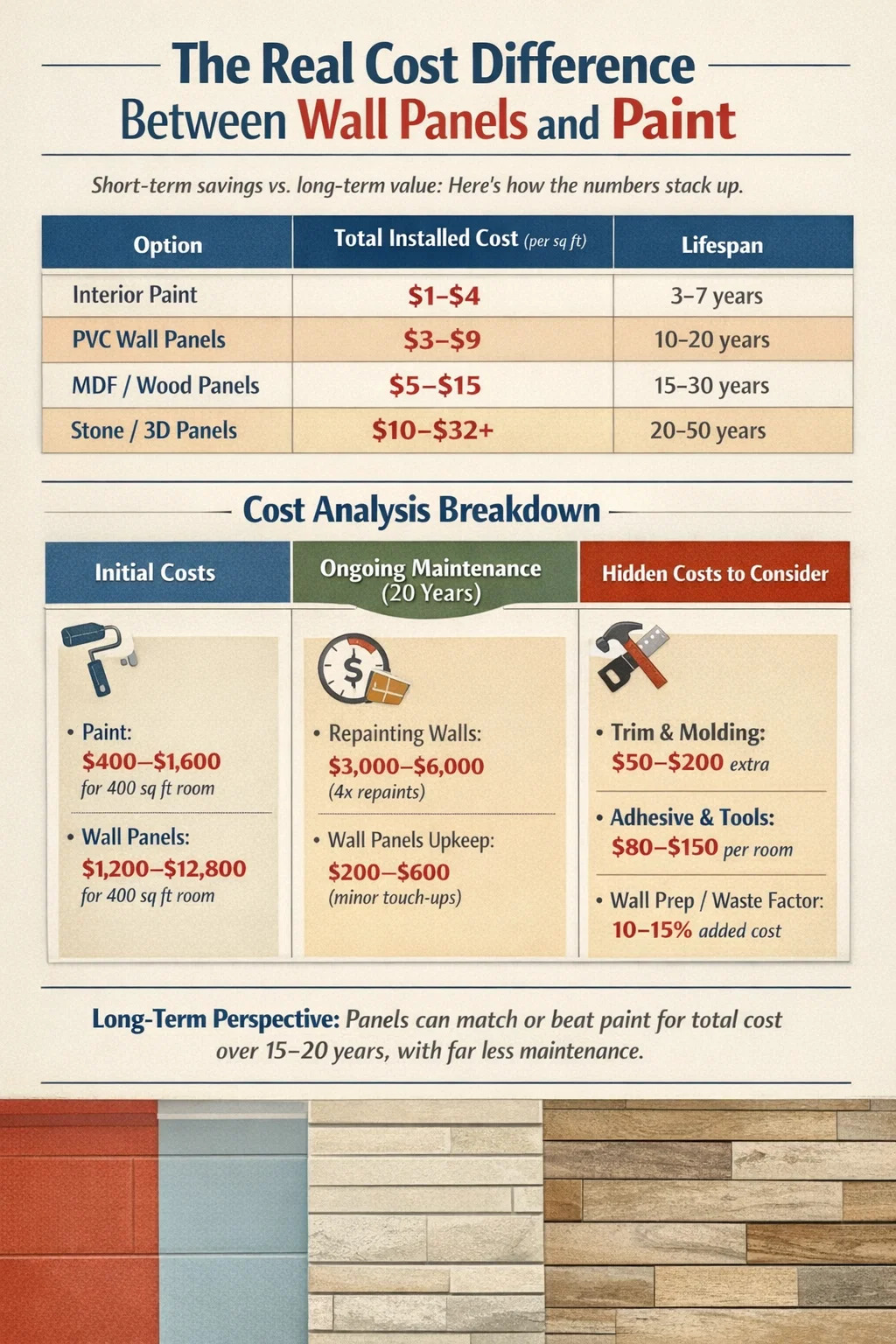
The price gap between paint and decorative wall panels is significant at the point of purchase, but it narrows considerably when you account for longevity, maintenance, and the labor involved over time. Here's a clear comparison of baseline costs:
| Option | Material Cost (per sq ft) | Labor Cost (per sq ft) | Total Installed (per sq ft) | Lifespan |
|---|---|---|---|---|
| Interior Paint | $0.20–$0.80 | $0.80–$2.50 | $1–$4 | 3–7 years |
| PVC Wall Panels | $1.50–$4 | $2–$5 | $3–$9 | 10–20 years |
| MDF / Wood Panels | $2–$8 | $3–$7 | $5–$15 | 15–30 years |
| Stone / 3D Panels | $5–$20+ | $5–$12 | $10–$32+ | 20–50 years |
For a standard 12×12 room with roughly 400 square feet of wall space, painting would cost approximately $400–$1,600, while installing decorative wall panels could run from $1,200 to $12,800 or more, depending on panel type. That's a substantial upfront difference — but you'd likely repaint that room two to three times before a quality panel installation needs any attention.
What Makes Paint So Affordable
Paint remains the most budget-accessible wall finish for several practical reasons. The materials themselves are inexpensive — a gallon of standard interior latex paint covers roughly 350–400 square feet and costs between $25 and $70 depending on brand and finish. Premium paints from brands like Farrow & Ball or Benjamin Moore can reach $100–$120 per gallon, but even these remain cheaper per square foot than most panel systems.
Labor is also relatively straightforward with paint. A professional painter typically charges $200–$500 per room for basic interior painting. If you're comfortable with a roller and brush, a full DIY paint job for an average bedroom might cost as little as $60–$120 in materials. Very few home improvement tasks offer that level of accessibility.
Prep work for painting is minimal compared to panel installation. You need to clean the wall, apply painter's tape, lay down drop cloths, and possibly apply one coat of primer — a task most homeowners can complete in a few hours without specialist tools.
Situations Where Paint Is the Clear Winner on Cost
- Rental properties where you need to refresh walls between tenants cheaply
- Rooms that change function frequently, like a nursery transitioning to a child's room
- Large open-plan spaces where covering every wall with panels would be prohibitively expensive
- Short-term living situations where you don't need permanence
- Projects with strict budget ceilings under $500
Understanding the True Cost of Decorative Wall Panels
Decorative wall panels are not a single product — they span a wide spectrum of materials, construction methods, and price points. Understanding what you're actually buying makes the cost comparison far more meaningful.
PVC and Vinyl Panels
PVC wall panels are among the most affordable panel options, typically priced between $1.50 and $4 per square foot for materials. They're lightweight, moisture-resistant, and widely used in bathrooms, kitchens, and basements. Installation is generally click-and-lock or adhesive-based, meaning a confident DIYer can install them without a contractor. Total installed cost including adhesive and trim runs approximately $3–$7 per square foot.
MDF and Wood Composite Panels
Medium-density fiberboard (MDF) paneling is one of the most popular choices for living rooms, bedrooms, and dining areas where a refined, architectural look is desired. Panel designs include shiplap, wainscoting, beadboard, and flat board styles. Material costs typically fall between $2 and $8 per square foot, with primed or pre-finished panels on the higher end. Professional installation, including cutting, nailing, caulking, and finishing, adds another $3–$7 per square foot.
One thing to note: MDF panels are often painted after installation, which means you're paying for both the panel system and paint. However, you only paint the panels once at installation and then perhaps once every 10–15 years, compared to repainting bare walls every 3–7 years.
3D Textured and Stone-Effect Panels
3D decorative wall panels — often made from polyurethane, gypsum, or natural stone — are the premium tier. Polyurethane 3D panels start at around $3–$8 per square foot, while genuine stone panels can exceed $20–$40 per square foot before installation. These are typically used as accent walls rather than full-room installations, which makes the overall project cost more manageable.
Hidden Costs of Panel Installation
Several costs are easy to overlook when budgeting for decorative wall panels:
- Trim and molding: End caps, corner pieces, and baseboards can add $50–$200 per room
- Adhesive and fasteners: Construction adhesive, finishing nails, and screws typically cost $30–$80 for an average room
- Wall preparation: If your existing walls are uneven or damaged, furring strips or drywall repairs may be needed before panels go up
- Waste factor: Panel installations typically require a 10–15% overage for cuts and mistakes
- Tool rental: A miter saw, level, and nail gun may be needed if you don't already own them — adding $50–$150 in rental costs
Long-Term Cost: Where Panels Can Beat Paint
When you calculate cost over a 20-year period, the equation shifts significantly. Paint requires reapplication every 3–7 years on average — more frequently in high-traffic areas, kitchens, bathrooms, and hallways. Each repainting cycle involves material costs plus labor (or your own time). Over two decades, that typically means 3 to 6 complete repaints.
For a standard 400 sq ft of wall space:
- Initial paint job: $600–$1,200 (professional)
- Repainting 4 times over 20 years: $2,400–$4,800 additional
- Total 20-year cost: $3,000–$6,000
Compare that with quality MDF decorative wall panels installed once:
- Initial installation: $2,000–$6,000
- One touch-up paint over 20 years: $200–$400
- Total 20-year cost: $2,200–$6,400
The ranges overlap — which means that for the same long-term spend, you can potentially have panels that look significantly better and require far less maintenance hassle. In rooms like bathrooms and kitchens, moisture-resistant PVC wall panels are especially cost-effective because they eliminate the mold-and-repaint cycle entirely.
Room-by-Room Cost Breakdown: Which Makes More Sense
The right choice isn't always the same from room to room. Here's how to think through each space in your home:
Bathroom
Bathrooms are one of the strongest arguments for wall panels. Moisture causes regular paint to peel, bubble, and develop mold within just a few years — especially in poorly ventilated spaces. Bathroom-specific paint (semi-gloss or satin with mold inhibitors) costs slightly more but still degrades quickly. PVC or composite wall panels, meanwhile, are fully waterproof and can last 15–20 years without issue. For a typical small bathroom with around 80–100 sq ft of wall space, the cost difference between paint ($80–$400) and PVC panels ($400–$900) is manageable, and the long-term maintenance savings favor panels clearly.
Living Room
Living rooms are where decorative wall panels deliver the most visual impact per dollar. A single accent wall using 3D panels or MDF wainscoting can transform the entire feel of a room at a fraction of the cost of a full installation. A feature wall of roughly 80–100 sq ft with MDF paneling costs approximately $600–$1,500 installed — a meaningful but not extravagant investment. Painting the rest of the room to complement the panels keeps the total cost reasonable.
Bedroom
Bedrooms see less wear and moisture than kitchens or bathrooms, which extends the life of paint considerably. A quality coat of paint in a bedroom can last 5–7 years without looking tired, which tips the cost-effectiveness calculation back toward paint for most people. If aesthetics are a priority, a paneled headboard wall is a popular middle-ground — costing $300–$800 for a typical bedroom wall while leaving the other three walls painted.
Kitchen
Kitchens benefit significantly from wall panels in the areas near the sink and stove, where grease, steam, and splashing water degrade paint quickly. Many homeowners opt for a hybrid approach: tiled or paneled backsplash areas behind cooking and prep zones, with standard painted walls elsewhere. This keeps costs controlled while addressing the areas most prone to deterioration.
Basement and Utility Rooms
Basements deal with humidity fluctuations, potential seepage, and temperature swings that are hard on painted surfaces. Moisture-resistant wall panels — particularly PVC or fiberglass-reinforced options — are worth the extra initial cost because basement repaints are frequent and messy. Installing panels in a basement can eliminate the need for repainting entirely over a 10–20 year period.
DIY vs. Professional Installation: How It Affects the Cost Gap
Labor is typically the largest single cost in any wall treatment project, and it's also the most controllable. Both paint and panels can be installed by a capable DIYer, but the skill gap between them is real.
DIY Painting
Painting is one of the most forgiving DIY tasks. Mistakes are easily fixed with a second coat. No power tools are required. Most homeowners can paint a standard room in a single day with basic preparation. A complete DIY paint job for a 12×12 bedroom might cost as little as $80–$150 in materials, making it genuinely accessible to anyone on a tight budget.
DIY Panel Installation
Some panel systems — particularly interlocking PVC panels and peel-and-stick products — are designed for DIY installation and don't require specialist skills. Tongue-and-groove PVC panels, for instance, can be installed with nothing more than adhesive, a utility knife, and a level. However, MDF and wood panel systems that require precise cutting and nailing are more demanding. Errors in measuring or cutting waste expensive material and create visible gaps. A moderately experienced DIYer can still do it, but plan for a full weekend and a learning curve.
If you go DIY on panels, you can cut the installed cost by roughly 40–60%, bringing mid-range MDF paneling down from $8–$12 per square foot to approximately $4–$6 per square foot in materials and consumables.
Visual Value and Perceived Quality: Does It Affect Resale?
Cost isn't just about what you spend — it's also about what you gain. Decorative wall panels, when well-chosen and properly installed, add a tangible sense of quality and craftsmanship to a room that paint simply cannot replicate. This matters if you're renovating with resale in mind.
Real estate agents frequently note that feature walls with wood or 3D paneling help homes photograph better and make stronger first impressions during viewings. While it's difficult to assign a precise dollar figure to this effect, homes staged with architectural wall features consistently attract more attention online and at open houses.
Paint, by contrast, is viewed as a baseline expectation by buyers — a freshly painted wall is noticed, but it doesn't add perceived value the way a paneled study wall or a wainscoted hallway does. A well-executed panel installation in a living room or primary bedroom can justify a $2,000–$5,000 premium in perceived value to prospective buyers, according to home staging consultants.
Maintenance Costs Over Time: Paint Requires More Attention
One of the most underappreciated costs of painting is the ongoing maintenance it demands. Painted walls scuff, chip, stain, and fade — and touching up paint is not as simple as it sounds. Paint colors change subtly as they age and as formulas are adjusted, which means touch-up patches often show. In practice, spot fixes lead to full repaints far more frequently than homeowners anticipate.
Decorative wall panels, particularly PVC and vinyl options, are highly resistant to everyday wear. They can be wiped clean with a damp cloth, resist light impacts without denting, and maintain their appearance for years without intervention. Wood and MDF panels can dent or scratch if subjected to heavy impacts, but they can usually be sanded and refinished rather than replaced entirely.
Annual Maintenance Cost Estimates
| Wall Finish | Annual Maintenance Cost (avg room) | Primary Maintenance Task |
|---|---|---|
| Paint (standard) | $80–$250 | Touch-ups, partial recoats |
| PVC Wall Panels | $0–$20 | Wiping down surfaces |
| MDF / Wood Panels | $20–$60 | Occasional repainting, minor repairs |
How to Decide: A Practical Framework
Rather than treating this as an either/or decision, most homeowners benefit from thinking about which surfaces and rooms are best served by each option. Here's a straightforward way to approach the decision:
- Identify high-moisture or high-wear areas first. Bathrooms, kitchens, laundry rooms, and basements are where panels justify their cost most clearly. Paint these areas repeatedly or panel them once — the math usually favors panels.
- Choose an accent-wall strategy for living spaces. Rather than paneling every wall in a living room or bedroom, select one focal wall for decorative wall panels and paint the remaining three. This approach delivers the visual impact of panels at roughly 25–30% of a full-room panel cost.
- Factor in how long you plan to stay. If you're in the home for fewer than 3 years, paint is almost certainly the better value. If you're planning a long-term stay of 10+ years, quality panels become increasingly competitive on a cost-per-year basis.
- Consider DIY potential. If you're comfortable with basic carpentry, DIY panel installation cuts costs dramatically. Add this factor into your comparison before ruling panels out on price alone.
- Match the material to the use case. Don't spend on natural stone panels where PVC will serve equally well. Reserve premium materials for high-impact areas where they'll be seen and appreciated daily.
Common Mistakes That Inflate the Cost of Both Options
Homeowners consistently overspend on both paint jobs and panel installations due to a handful of avoidable errors:
- Skipping primer: Unprepared or newly plastered walls absorb more paint, requiring extra coats. Always prime before painting to reduce total paint consumption by 20–30%.
- Underestimating panel quantities: Not accounting for 10–15% waste on cuts leads to mid-project shortages. If you run out of a discontinued panel style, replacing mismatched panels is expensive.
- Choosing the wrong paint sheen for the room: Flat paint in a high-traffic hallway will need repainting within 2 years. Using the appropriate satin or semi-gloss finish in washable areas extends the life of a paint job significantly.
- Installing panels over problem walls: Panels installed over walls with moisture problems, mold, or structural cracks will trap the underlying issue and lead to much more expensive remediation later.
- Choosing premium materials for low-visibility areas: Stone-effect 3D panels in a utility room or back hallway deliver zero return on investment. Match material quality to how much the space is used and seen.
Final Verdict: Which Is Actually Cheaper
Paint is cheaper in the short term, always. For immediate budget constraints, small projects, or situations where flexibility matters, paint wins without question. If you have $500 to spend on a room, paint is the only realistic option.
But the full cost picture tells a different story. Over 15–20 years, quality decorative wall panels — particularly in moisture-prone or high-traffic areas — can cost the same or less than repeatedly painting the same surfaces, while delivering dramatically better aesthetics and far lower maintenance burden.
The smartest approach for most homeowners is a hybrid one: use panels strategically in bathrooms, kitchens, basements, and on feature walls, and use paint everywhere else. This maximizes the practical benefits of panels without the cost of a whole-home panel installation, and keeps flexible, low-cost paint where it performs well.
If you're comparing total lifetime cost on a per-square-foot basis and are willing to invest upfront, panels are not the expensive option people assume them to be. They're a calculated trade: more money now, less time and money spent later.

 ++86-18906857262 / ++86-13754347028
 No.49, Tunnan Industrial Zone, Daohui Street, Shangyu District, Shaoxing City, Zhejiang Province, China