

 English
 русский
 عربى
عربى

A set of design, research and development, production, sales, installation in one of the professional new decorative materials enterprises.
Content
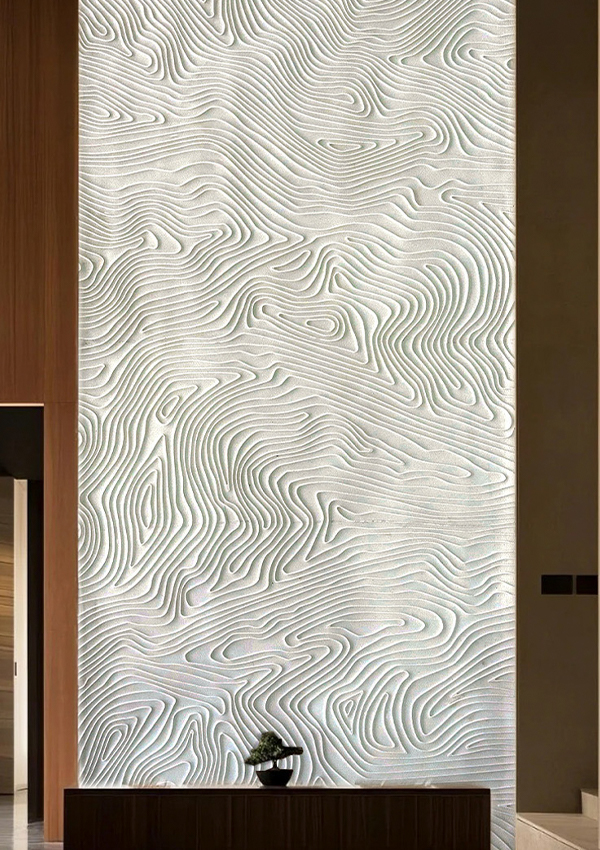
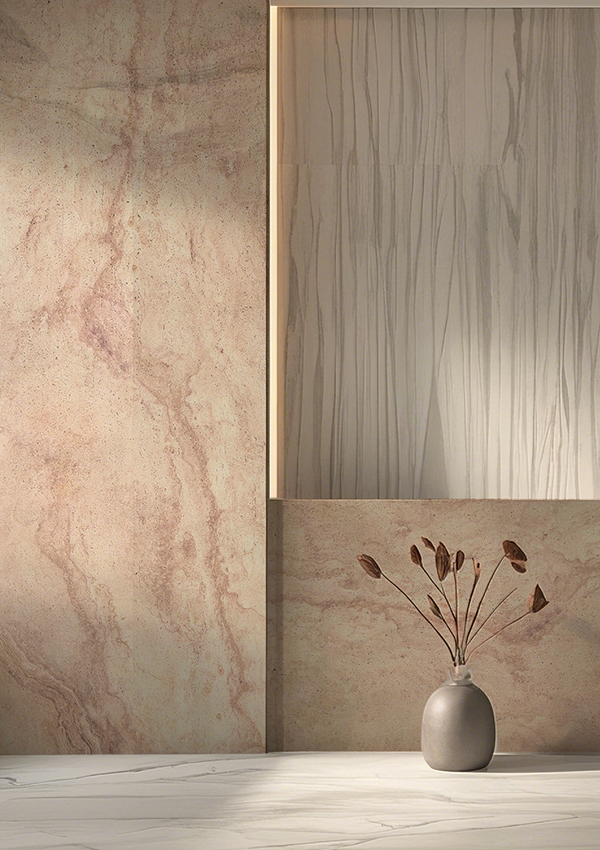
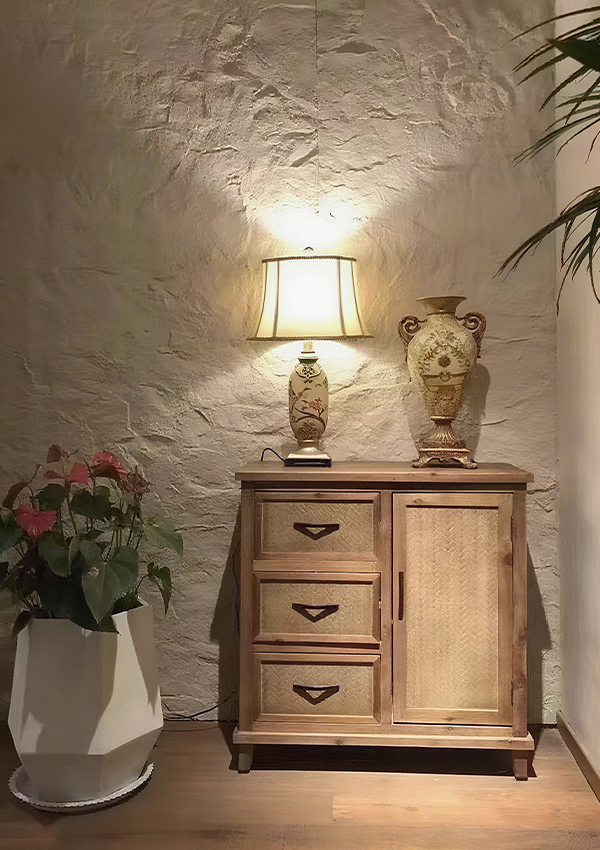
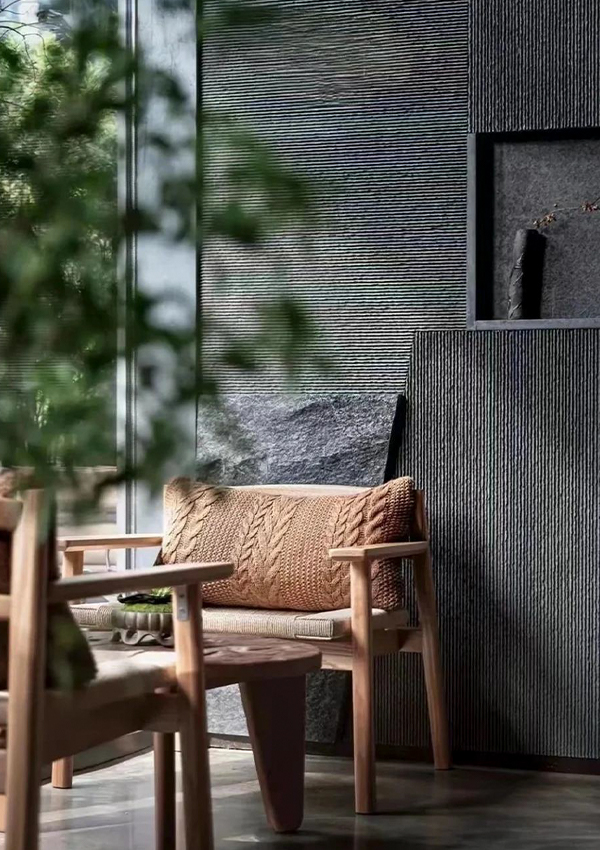
Soft stone—often called flexible stone or MCM soft ceramic—is developed as a decorative surface material that can bend and follow irregular structures. Unlike ceramic tiles or natural stone panels, which are rigid and difficult to shape on site, this material can conform to curved and complex surfaces with minimal processing.
In construction practice it is sometimes referred to as flexible facing stone, bendable stone veneer, or curved decorative soft stone. Because of its formability, it is commonly selected for surfaces such as columns, arches, rounded corners, curved feature walls, and other architectural elements where standard stone products are difficult to apply.
Flexural performance is specified in JG/T 540-2017 Clause 6.3. Testing shows that the material can be bent to a radius of less than 20 mm without cracking, surface damage, or separation between layers. The structure remains stable during cutting, bending, or wrapping operations carried out during installation.
These characteristics make it suitable for applications including curved exterior façades, cylindrical walls, arched entrances, bay windows, and interior decorative surfaces. Traditional rigid panels often require complicated cutting and jointing to achieve similar shapes. With soft stone, the installation process is simpler and material loss is reduced, while the finished surface retains the appearance of natural stone.
Because of its light weight and flexibility, architects and designers are able to apply it in projects where conventional stone would be difficult to use. Commercial interiors, hotels, exhibition spaces, and villa renovations are typical examples where this material is frequently adopted.
Durability of Soft Stone Under Extreme Environmental Conditions
Soft stone (flexible stone / MCM soft ceramic) is designed for long-term use in both interior and exterior environments. Its material composition allows it to perform reliably in situations where temperature fluctuations or high humidity would affect traditional decorative materials.
Performance testing follows a number of national and industry standards.
Low-temperature resistance
Based on JG/T 540-2017, the material can tolerate temperatures down to −40 °C. Repeated freeze–thaw cycles do not result in cracking or powdering of the surface.
High-temperature stability
Testing conducted according to JG/T 579-2021 indicates that soft stone can withstand long-term exposure to temperatures of about 60 °C. Short-term exposure between 80 °C and 100 °C does not lead to softening or deformation.
Performance in humid conditions
Under the requirements of GB 50210-2018, the product shows resistance to moisture and mildew. Problems such as water seepage, detachment of the decorative layer, or surface discoloration are unlikely to occur in properly installed systems.
Soft stone is mainly composed of inorganic mineral materials combined with a specially formulated flexible binder. This composition gives the material durability while maintaining a stone-like surface texture and relatively low maintenance requirements.
UV Resistance and Weathering Performance of Soft Stone for Exterior Walls
For exterior wall applications, resistance to sunlight and environmental aging is essential. Soft stone is formulated to maintain color stability and surface integrity during long-term outdoor exposure.
Testing for ultraviolet resistance follows GB/T 1865-2022 and JG/T 311-2011. Under xenon lamp aging tests, samples exposed for 1500 hours show a color difference of ΔE ≤ 2.5. No obvious fading, yellowing, or surface chalking is observed.
Weathering resistance is also evaluated under GB 50210-2023 and CECS 376-2014. The mineral-based composition combined with flexible bonding components allows the material to remain stable under long-term environmental stress. Artificial aging tests exceed 3500 hours, which corresponds to an estimated outdoor service life of roughly 40 to 50 years.
Another advantage is its ability to accommodate minor movement in the substrate. Small structural shifts or thermal expansion in the wall system can be absorbed by the flexible layer, reducing the likelihood of surface cracking. Additional protective coatings are generally unnecessary, which simplifies installation and reduces maintenance work over time.
Exterior Wall System Combining Soft Stone with Insulation Boards
Soft stone is frequently used as the finish layer in composite exterior wall systems that incorporate thermal insulation boards. This type of assembly combines decorative finishing with energy-saving performance and structural reliability.
Typical insulation materials used in the system include EPS boards, rock wool boards, and polyurethane insulation panels. Together with the soft stone finish layer, the system provides both thermal protection and an exterior surface resembling natural stone.
Several advantages explain its increasing use in façade construction. The flexibility of the surface layer allows it to adapt to slight movement in the base wall or insulation layer. This helps prevent cracking or detachment that may occur with rigid finishing materials. The overall weight is significantly lower than that of traditional stone cladding—generally only one-fifth to one-tenth—reducing structural load on the building.
Thermal insulation performance can meet the requirements of JGJ 26 and GB 50189, which address energy-efficient building design. In addition, the surface layer provides a certain level of water resistance and helps protect the insulation system from external moisture.
From inside to outside, the system typically consists of the base wall, a cement mortar leveling layer, a polymer bonding layer, the insulation board, reinforced finishing mortar with alkali-resistant fiberglass mesh, the soft stone decorative layer, and mechanical anchors that improve wind resistance.
A practical example is the Shanghai Philharmonic Orchestra Concert Hall in Jing’an District. The building was renovated in 2018 using rock wool insulation boards combined with granite-effect soft stone cladding. After several years of use, the exterior surface remains stable with no visible deformation or fading.
Another large-scale application was the 2010 Guangzhou Asian Games Urban Facade Renovation Project. Approximately 500,000 square meters of building surfaces were upgraded using EPS insulation boards and MCM soft ceramic finishes. The construction schedule was shortened by roughly 30%, and most façades remain in good condition after more than a decade of service.
Fire Performance of Soft Stone and Compliance with Building Safety Codes
Soft stone (flexible stone or MCM soft ceramic) is also specified in many projects because of its fire-safety characteristics. While providing a stone-like decorative surface, the material can meet strict building fire performance requirements.
In technical documentation it may be described as A2-class non-combustible soft stone, fire-resistant flexible stone veneer, or fire-rated MCM cladding.
Fire classification follows the standard GB 8624-2012. Within this system, the rating A2-s1,d0 indicates limited combustibility, low smoke production, and no flaming droplets during combustion.
Most high-performance soft stone products reach Class A2, and certain formulations may achieve Class A1. This level of fire resistance allows the material to be used on high-rise façades, commercial buildings, and public facilities where strict fire regulations apply.
The fire performance is largely due to the high proportion of inorganic mineral materials in the composition. Because of this, soft stone can serve both as a decorative façade finish and as part of a fire-resistant building envelope.
As building safety regulations become stricter—particularly with standards such as GB 55037-2022—demand for non-combustible façade materials continues to grow. Soft stone has therefore become an increasingly common option in modern façade design.


 ++86-18906857262 / ++86-13754347028
 No.49, Tunnan Industrial Zone, Daohui Street, Shangyu District, Shaoxing City, Zhejiang Province, China