

 English
 русский
 عربى
عربى

A set of design, research and development, production, sales, installation in one of the professional new decorative materials enterprises.
Content
- 1 What Fiberglass Reinforced Plastic Paneling Actually Is
- 2 How FRP Paneling Compares With Other Common Wall Materials
- 3 Where FRP Paneling Earns Its Keep: Real-World Applications
- 4 Five Purchase Pitfalls That Cause Costly FRP Panel Failures
- 5 Maintenance Reality Check: What You Actually Need to Do
- 6 When Flexible Stone Wall Panels Make More Sense Than FRP
- 7 How to Decide: A Practical Buyer's Checklist
- 8 Frequently Asked Questions About FRP Paneling
- 8.1 Can FRP panels be used outdoors without special treatment?
- 8.2 What causes FRP panels to yellow?
- 8.3 How do I inspect an incoming FRP panel for quality?
- 8.4 Is FRP paneling safe for food-processing environments?
- 8.5 How should FRP panels be prepared for a retrofit project?
- 8.6 Why do some FRP panels look wavy even after installation?
If you are evaluating fiberglass reinforced plastic paneling for a commercial building, cleanroom, food facility, or even a hospital corridor, the first thing to know is that thickness, resin content, and installation design matter far more than the word “fiberglass” itself. A well-specified FRP panel can deliver 15–20 years of trouble-free service in a wet or chemically aggressive environment. A poorly specified one can blister in two years, turn yellow within eight months, or develop tell-tale glass fiber shadows on the surface. This guide explains how to make that call based on real project conditions, what measurements to request from suppliers, and when an alternative such as flexible stone wall paneling gives you a better result.
What Fiberglass Reinforced Plastic Paneling Actually Is
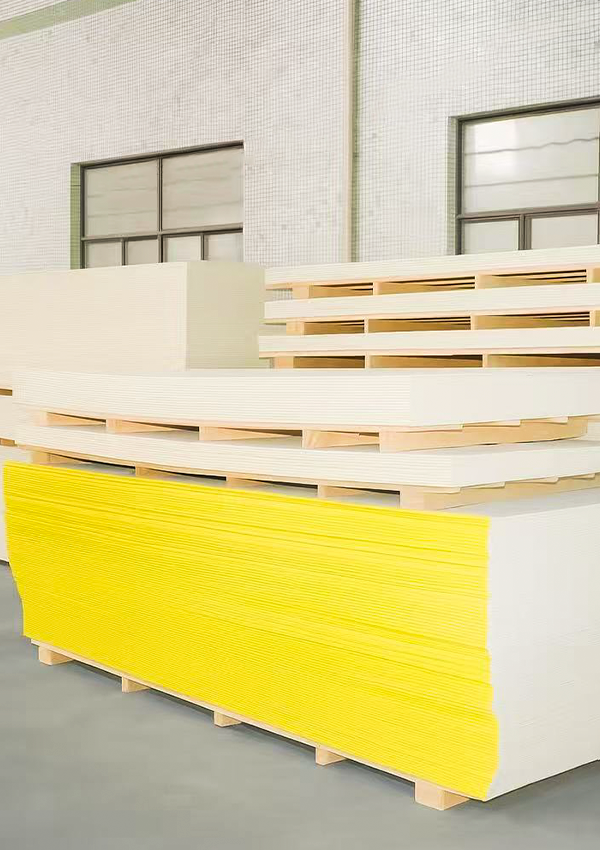
Fiberglass reinforced plastic (FRP) is a composite material made by embedding glass fibers in a thermoset resin matrix. The resin is usually polyester, vinyl ester, or epoxy, while the fibers come as chopped strand mat, woven roving, or continuous filament. This combination produces a panel that is stronger than steel by weight, resistant to many chemicals, and capable of being moulded into smooth, easily washed surfaces.
In architectural and industrial wall applications, FRP panels are typically manufactured with a gel coat on the exposed side. The gel coat is a thick resin layer that protects the glass fibers and determines the final gloss, colour, and weatherability. A good gel coat will be 0.4–0.6 mm thick. Below 0.3 mm, the panel can show “fiber print” – a faint woven pattern that appears after a few months of use.
Commercial FRP sheets come in thicknesses of 2.0 mm, 2.5 mm, 3.0 mm, and 4.0 mm. The difference in flexural strength between a 2.0 mm and a 3.0 mm panel can be over 100 MPa. For walls that will be hit by carts, trolleys, or equipment, a 3.0 mm or 4.0 mm panel with high resin content is a safer investment than a thin, cheap alternative.
How FRP Paneling Compares With Other Common Wall Materials
Understanding where FRP fits relative to other wall panels keeps you from over-specifying or under-specifying a project. The table below summarises typical performance figures used in construction specification.
| Performance Indicator | FRP Panel | Flexible Stone Wall Panel | Bamboo-Fiber Wall Board |
|---|---|---|---|
| Thickness Range | 2.0–4.0 mm | 3.0–8.0 mm | 8.0–10.0 mm |
| Flexural Strength | 150–250 MPa | 80–150 MPa | 20–50 MPa |
| Weight per m² | 2.8–5.0 kg | 1.5–3.5 kg | 6.0–8.0 kg |
| Surface Texture | Glossy or matte resin | Natural stone, wood, cement | Wood grain or flat |
| Moisture Resistance | Excellent | Excellent | Good (needs edge sealing) |
| Suitability for Exterior Walls | Needs UV-stabilised resin | Suitable | Not recommended |
Notice that FRP wins on raw strength and impact resistance, while flexible stone panels win on visual naturalness and weight. Bamboo-fiber board is a budget-friendly, thicker interior option but needs careful edge sealing in wet areas.
Where FRP Paneling Earns Its Keep: Real-World Applications
FRP wall panels are not generic “nice-looking” panels. They are engineered for environments where frequent washing, chemical exposure, or heavy contact would ruin painted drywall, wood laminate, or even stainless steel. The following areas are the most common and most appropriate use cases:
- Food processing plants and commercial kitchens, where daily chlorine-based cleaning is mandatory. A well-maintained FRP wall can survive this regime for 15 years or more.
- Hospitals, clinics, and pharmacies, where smooth, non-porous surfaces are required for infection control and where wheeled equipment constantly scrapes walls.
- Garage walls and industrial workshops, where oil, grease, and mechanical impacts are everyday realities.
- Agricultural buildings such as poultry houses and livestock sheds, which need panels that can be pressure-washed with disinfectants.
Two Warning Signs Before You Specify FRP for Outdoor Use
First, ordinary polyester resin will yellow and chalk rapidly in direct sunlight. If the panel is for a north-facing façade or interior, this may be acceptable. For a south-facing or exposed exterior, always request UV-stabilised resin or a vinyl-ester gel coat. Second, check the coefficient of linear expansion. FRP expands more than aluminium and far more than stone. In a coastal high-rise project observed in 2021, non-UV-treated FRP panels on a south façade lost 40% of their initial gloss within 18 months, while adjacent UV-treated panels were still carrying a deep shine.
Five Purchase Pitfalls That Cause Costly FRP Panel Failures
Buying FRP panels is not a “pick a colour and you are done” exercise. Even a small mistake in specification can lead to expensive rework. Here are the five issues that most often create claims and callbacks:
- Only checking thickness, not resin content. A 3.0 mm panel with 40% resin can delaminate far faster than a 2.5 mm panel with 60% resin. Ask suppliers for resin weight percentage in the laminate.
- Forgetting gel coat thickness. A gel coat under 0.3 mm is a false economy. When the gel coat wears away, fibres show through, and the panel becomes impossible to clean.
- Ignoring fire-resistance constraints. In commercial buildings, you want a resin system that is flame-retardant. Ask for “flame-retardant grade” rather than “self-extinguishing”; the terms are not interchangeable.
- Improper fixing spacing. For a 3.0 mm panel, fixing points should be spaced no more than 300 mm along the edge and 400 mm in the middle. Larger spacing leads to visible bowing, particularly where temperature changes cause expansion.
- Low flatness on the substrate. FRP is flexible enough to follow minor irregularities, but it will mirror them. A 1 mm bump becomes a visible “denting” effect under direct light. Prepare a flat backing surface before installation.
Maintenance Reality Check: What You Actually Need to Do
FRP panels look low-maintenance, and they are, but not zero-maintenance. For an average commercial installation, the annual maintenance routine is simple:
- Wash with a mild neutral detergent and a soft cloth or sponge. Avoid abrasive pads and strong caustic cleaners.
- Inspect the edge trims and corner junction seals every 24 months. If the sealant is cracked or peeling, replace it before water can migrate behind the panel.
- In commercial kitchens, clean the panel within one hour of any alkaline splash. Prolonged contact with substances like sodium hydroxide can etch the resin surface.
- In coastal or high-humidity environments, wipe down any salt residue on outdoor-facing panels quarterly.
If your facility contains strong acids or oxidising agents, consider a vinyl-ester resin FRP panel. The panel will cost roughly 10–20% more, but in a chemical plant, the service life can be more than double that of ordinary polyester FRP. This is a concrete payback calculation, not a marketing claim.
When Flexible Stone Wall Panels Make More Sense Than FRP
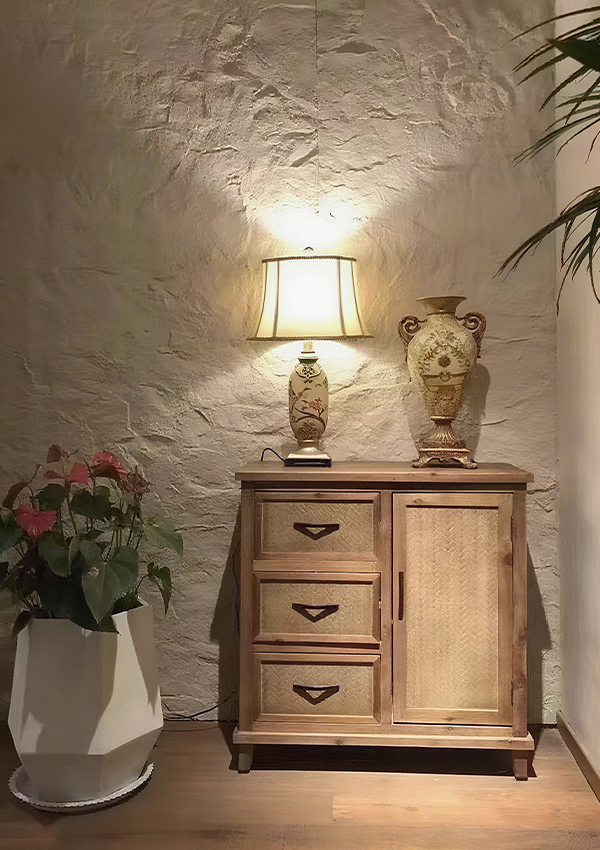
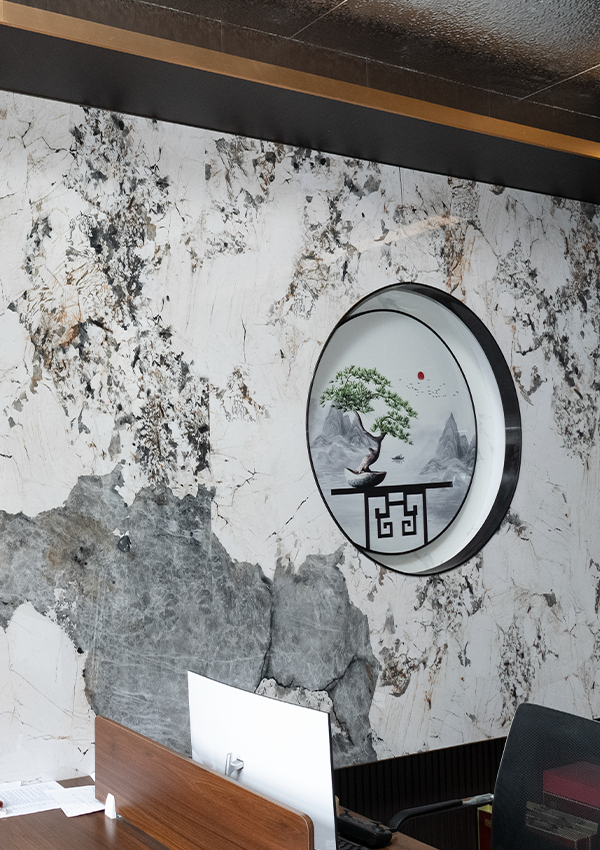
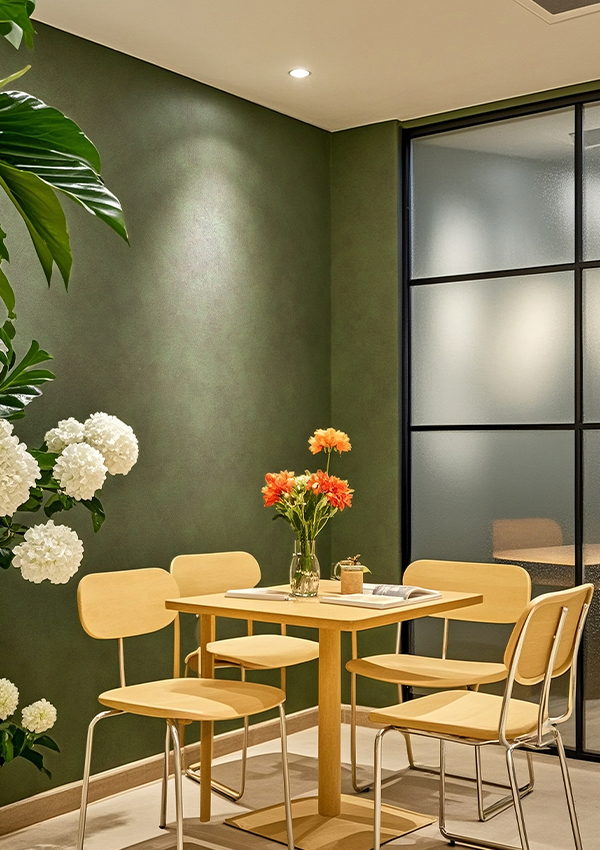
Despite FRP’s strengths, there is a large category of building projects where a glossy resin surface is simply the wrong visual language. For hotel lobbies, medical waiting rooms, private offices, retail interiors, and modern residential spaces, owners and designers want a surface that looks like real slate, travertine, cement, or wood – without the weight and fragile joints of stone slabs, and without the sterile feel of resin. That is exactly where flexible stone wall panels come in.
Flexible stone products, such as those from Shaoxing Mingyou Decoration Materials, combine mineral fillers with a pliable polymer binder. They can bend to fit curved columns and arches, are much lighter than traditional stone, and are installed with a simple adhesive rather than a full curtain-wall frame. They give you the stone texture you want with a thickness of 3–8 mm and a weight of only 1.5–3.5 kg per square metre. For a renovation project with an uneven wall or a tight schedule, this can save days of framing work.
 Slate Flexible Soft Stone Wall Panel for Curved SurfacesThis ultra-thin panel with natural slate texture bends to fit columns and arches, while being lightweight and adhesive-installed, offering a practical renovation solution for uneven walls.View Product →
  3D Brick Flexible Soft Stone Wall Panel for Textured FacadesThis panel combines a 3D brick profile with flexible backing, enabling quick installation and providing a visually dynamic surface suitable for both exterior facades and interior feature walls.View Product →
  Cement-Look Flexible Soft Stone Wall Panel for Industrial StyleWith a raw concrete appearance and A2 fire rating, this panel adapts to curved structures while offering a lightweight alternative for modern or loft-style renovations.View Product →
If you are weighing FRP against this alternative, think about the type of cleaning regime first. FRP wins when the wall will be pressure-washed with harsh chemicals. Flexible stone panels win when the look of natural stone is the priority and the wall receives normal commercial cleaning. In a hospital corridor, for example, flexible stone panels can deliver a calm, warm atmosphere while still being wipeable with standard disinfectants.
One more practical point: flexible stone panels are not brittle like sintered stone or ceramic tile, so they can absorb light impacts without cracking. If the budget allows for a façade or lobby that needs to look like it cost more than it does, the alternative is worth considering. For deeper technical reading on woven-pattern flexible stone panels, see our dedicated buyer guide on weaving-pattern flexible stone wall panels. If your project is more about wood surfaces, a wood veneer paneling system may fit the interior scheme better while still offering a renewable, elegant finish.
How to Decide: A Practical Buyer's Checklist
When you sit down with a supplier, run through this checklist to avoid ending up with a wall material that does not match the actual service conditions.
- Will the wall face strong chemical / acid exposures? Yes → vinyl-ester FRP or flexible stone with high mineral content. No → standard polyester FRP is acceptable.
- Is the area open to direct sunlight? If yes, UV-stabilised FRP or flexible stone. If no, ordinary resin may suffice but will still yellow faster than you expect.
- Will carts, trolleys, or heavy furniture be pushed against the wall? Yes → min. 3.0 mm FRP or a 4.0 mm flexible stone with good impact resilience. No → 2.0 mm FRP can be acceptable in a low-traffic office.
- Does the client want a “natural stone” or “warm wood” look? Flexible stone wall panels and wood veneer paneling will deliver that without the weight of stone.
- What is the available installation window? If it is 3 days, choose adhesive-installed panels. If it is 1 day, choose flexible stone, which can be cut on-site with a utility knife.
Frequently Asked Questions About FRP Paneling
Can FRP panels be used outdoors without special treatment?
Yes, but only if the resin is UV-stabilised and the gel coat is thick enough. A standard polyester panel will chalk and yellow in the sun. If the application involves a south-facing wall, insist on a UV-resistance test report from the manufacturer.
What causes FRP panels to yellow?
Yellowing is primarily a chemical reaction between ultraviolet light and the resin polymer. In most cases, it starts as a slight colour shift after 6–12 months of direct UV exposure. Vinyl-ester and certain acrylic-modified resins show much better colour stability than inexpensive orthophthalic polyester.
How do I inspect an incoming FRP panel for quality?
Look at the cut edge. A good laminate should show a dense resin-rich layer on the outside, then a fibre mat that is fully wetted out. If you see dry spots, gaps, or white uncoated fibres, that panel is already compromised. Check the gel coat thickness with a magnetic or ultrasonic gauge if possible.
Is FRP paneling safe for food-processing environments?
Yes, when the surface is completely free of pinholes and the laminate is dense. Pinholes are tiny air bubbles that can trap bacteria. A food-grade FRP panel should be inspected under strong lighting for any surface defects before installation.
How should FRP panels be prepared for a retrofit project?
Remove any failing paint or loose substrate. Fill cracks and level the surface. Use a moisture barrier if the wall is concrete. Then bond the FRP with a compatible adhesive and mechanically fix at the recommended spacing. Ensuring a flat backing is the single biggest factor in a smooth final appearance.
Why do some FRP panels look wavy even after installation?
This is usually a combination of insufficient flatness in the substrate and fixing points spaced too far apart. It can also happen if the panel was stored in a hot warehouse before installation and expands when exposed to sunlight. Letting the panels acclimatise on site for 24 hours prior to installation reduces this risk.


 ++86-18906857262 / ++86-13754347028
 No.49, Tunnan Industrial Zone, Daohui Street, Shangyu District, Shaoxing City, Zhejiang Province, China