

 English
 русский
 عربى
عربى

A set of design, research and development, production, sales, installation in one of the professional new decorative materials enterprises.
Content
- 1 What Does Paneling Mean? The Short Answer First
- 2 The History Behind Wall Paneling
- 3 Types of Decorative Wall Panels: A Detailed Breakdown
- 4 Material Comparison: Which Decorative Wall Panel Works Best Where
- 5 What Paneling Does for a Room Beyond Looks
- 6 Current Trends in Decorative Wall Panels
- 7 How to Install Decorative Wall Panels: Core Methods
- 8 Room-by-Room Guide to Using Decorative Wall Panels
- 9 Cost Guide: What to Budget for Decorative Wall Panels
- 10 Common Mistakes to Avoid When Installing Wall Panels
- 11 How Paneling Affects Property Value
- 12 Frequently Confused Terms Related to Paneling
What Does Paneling Mean? The Short Answer First
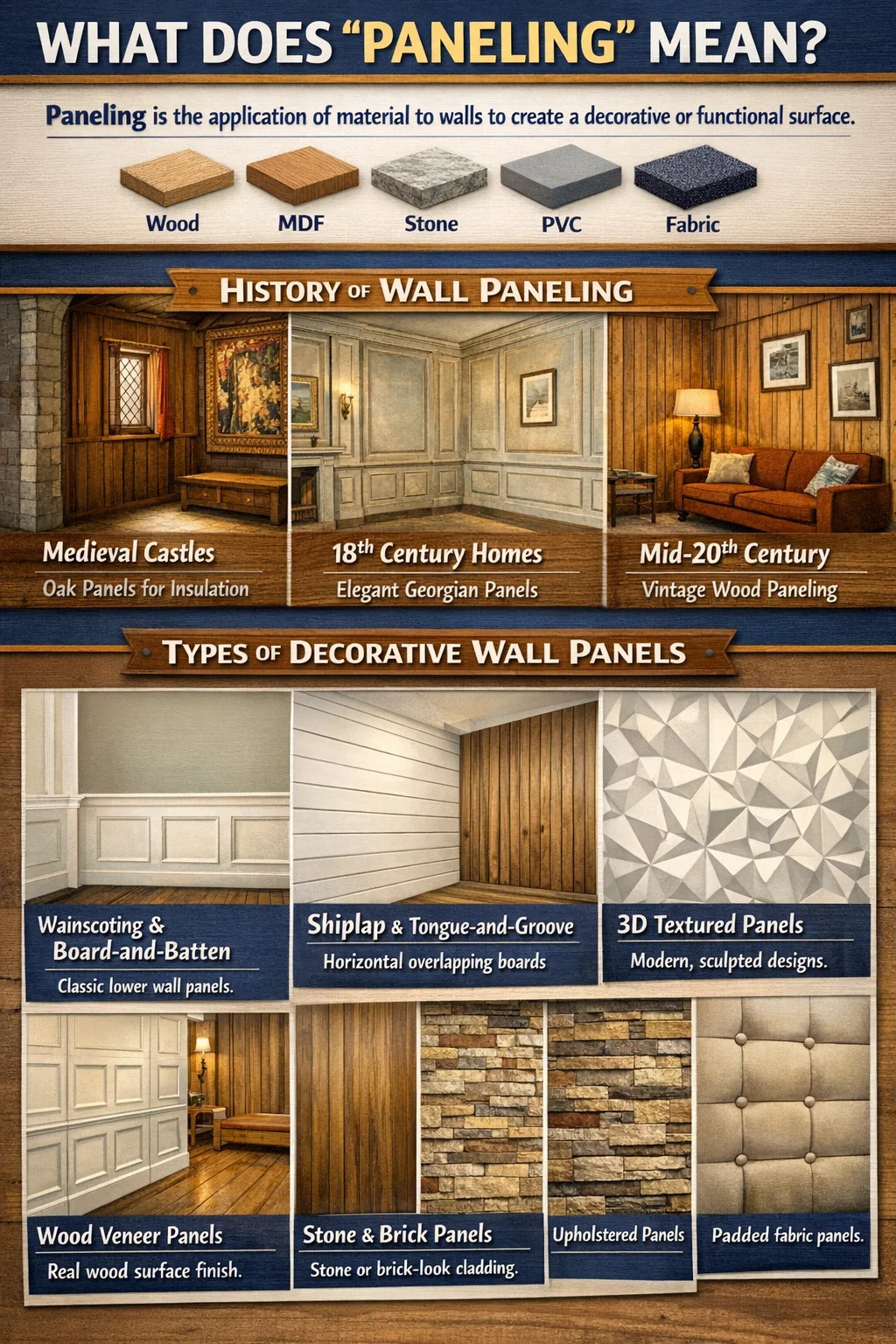
Paneling refers to the application of flat or three-dimensional sections of material — wood, MDF, PVC, stone, fabric, or metal — onto walls, ceilings, or other surfaces to create a finished, decorative, or functional layer. In interior design, the term most commonly describes decorative wall panels used to add texture, depth, pattern, or insulation to a room's surfaces. Paneling is not a single product but an entire category of wall treatments that spans everything from traditional wainscoting in Victorian hallways to contemporary fluted oak accent walls in minimalist apartments.
The word itself comes from the Old French panel, meaning a piece of cloth or a section of a surface. Over centuries it evolved in the building trades to describe any prefabricated or site-built section installed as a wall covering. Today, when a homeowner, contractor, or interior designer says "paneling," they almost always mean a decorative or protective surface treatment rather than a structural element.
If you are searching for what paneling means because you are planning a renovation, shopping for wall coverings, or trying to understand a design trend you have seen online, the practical takeaway is this: paneling is a wall finishing system that changes how a surface looks, feels, and sometimes performs acoustically or thermally. Everything else — material, style, installation method, cost — flows from that core definition.
The History Behind Wall Paneling
Wall paneling has been part of architecture for well over a thousand years. Medieval European castles used heavy oak boards to line stone walls, serving a dual purpose: they reduced drafts and created a surface that could be decorated with tapestries, carved motifs, or painted scenes. By the 17th century, raised-panel wainscoting had become a status symbol in English country homes, with craftsmen spending months fitting together intricate frames and recessed panels along lower walls.
In the 18th century, Georgian and Federal-style architecture brought more refined proportions to wall paneling. Full-height paneled walls with classical pilasters and cornices became the mark of a well-appointed home. The mid-20th century saw a dramatic shift: cheap knotty pine and faux-woodgrain hardboard panels flooded the residential market in the 1950s and 1960s, and the aesthetic backlash against those products gave "wood paneling" a somewhat dated reputation for several decades.
Since roughly 2015, a strong revival has taken hold. Decorative wall panels are now one of the fastest-growing segments in the home improvement market. According to a 2023 report by Grand View Research, the global architectural panels market was valued at over $230 billion and is projected to grow at a compound annual rate of approximately 6.2% through 2030. Much of that growth is driven by residential renovation projects and the explosion of interior design content on platforms like Pinterest and Instagram, where paneled accent walls routinely go viral.
Types of Decorative Wall Panels: A Detailed Breakdown
Understanding what paneling means in practice requires knowing the major categories available today. Each type has a distinct look, installation method, cost range, and ideal use case. Below is a structured overview.
Wainscoting and Board-and-Batten
Wainscoting covers the lower portion of a wall, typically between one-third and one-half of the total wall height. It traditionally combines a bottom rail, vertical stiles, horizontal rails, and recessed or raised center panels. Board-and-batten is a simplified version: flat vertical boards (the "boards") are fixed to the wall, and narrow strips (the "battens") cover the seams. Board-and-batten has seen enormous popularity in Scandinavian-influenced and farmhouse-style interiors since around 2018.
Wainscoting typically runs between $1,000 and $4,000 for a standard dining room when professionally installed, depending on the wood species and panel complexity. DIY board-and-batten kits from retailers like Home Depot or IKEA can reduce that figure significantly, with materials for a single accent wall often costing under $150.
Shiplap and Tongue-and-Groove
Shiplap panels have a rabbet cut along each edge so that adjacent boards overlap slightly, creating a shadow line. Originally a construction technique for sealing exterior walls against weather, shiplap became a ubiquitous interior design element after Joanna Gaines popularized it on the television program Fixer Upper. Tongue-and-groove panels interlock with a protruding tongue on one edge fitting into a groove on the next, creating a tighter, flatter surface. Both styles work on walls and ceilings.
Real pine shiplap runs approximately $2.50 to $7.00 per square foot for materials alone. PVC and MDF versions designed to mimic the look come in at $1.50 to $4.00 per square foot and offer better moisture resistance in bathrooms and kitchens.
3D Textured Wall Panels
Three-dimensional decorative wall panels are among the most visually dramatic options. They are manufactured from materials including gypsum, polyurethane foam, bamboo fiber composite, and MDF. Designs range from geometric hexagons and interlocking diamonds to organic wave forms and rippled surfaces inspired by sand dunes or fabric folds. When lit with directional lighting, the relief surface creates shifting shadows that give a room a dynamic, almost sculptural quality.
Gypsum 3D panels average $3 to $10 per square foot for materials and are paintable after installation. Polyurethane options, which are lighter and more impact-resistant, run $4 to $14 per square foot. A common application is a single feature wall behind a bed or sofa — typically 40 to 60 square feet — making the total material cost manageable even for premium designs.
Wood Veneer and Solid Wood Panels
Wood veneer panels bond a thin slice of real hardwood — walnut, oak, teak, maple, or ash — to an MDF or plywood substrate. This delivers the authentic grain, warmth, and natural variation of solid wood at a fraction of the weight and cost. Solid wood planks are also used directly, particularly in high-end residential and commercial projects. Fluted wood panels, which feature parallel vertical grooves routed into the surface, have been especially popular in contemporary interior design since 2020.
Walnut veneer panels typically cost $8 to $20 per square foot. Oak veneer is more accessible at $5 to $12 per square foot. Solid hardwood planking for walls can exceed $30 per square foot installed, placing it firmly in the luxury renovation category.
PVC and Composite Panels
PVC (polyvinyl chloride) wall panels are waterproof, lightweight, and easy to clean, making them a practical choice for bathrooms, kitchens, laundry rooms, and commercial spaces like restaurants or retail environments. Many PVC panels are printed with photorealistic wood, stone, or marble patterns using digital UV printing technology. They click or glue directly to existing walls without requiring a plaster skim coat or priming.
PVC wall panels are among the most budget-friendly options, often retailing for $1.00 to $3.50 per square foot. The trade-off is that they lack the tactile authenticity of natural materials and can look noticeably synthetic under close inspection.
Stone, Brick, and Concrete-Effect Panels
Natural stone cladding panels are thin slices of real slate, quartzite, travertine, or marble fixed to a mesh backing for wall installation. Faux versions — made from lightweight polyurethane or fiber-reinforced gypsum — replicate the look at a fraction of the weight and cost, which is important since real stone can add significant structural load to a wall. Exposed brick-effect panels and raw concrete panels follow the same logic: manufactured panels that deliver an industrial or rustic aesthetic without the expense or complexity of the real thing.
Real stone wall cladding typically costs $15 to $40 per square foot installed. Faux polyurethane stone panels run $3 to $9 per square foot and can be installed by a competent DIYer in a single weekend.
Fabric and Upholstered Wall Panels
Upholstered panels consist of a rigid backing — typically MDF or foam board — wrapped in fabric or leather and fixed to the wall. They are used in bedrooms, home theaters, dining rooms, and hospitality environments. Beyond their visual appeal, fabric panels provide meaningful acoustic dampening. A fabric-wrapped panel with a 50mm acoustic foam core can reduce mid-frequency reverberation by 30 to 50%, which explains their widespread use in recording studios and podcast rooms.
Custom upholstered wall panels are priced by the square foot based on fabric selection and backing thickness. Budget fabric options start around $8 per square foot; premium leather or velvet panels can reach $50 to $80 per square foot for bespoke commercial installations.
Material Comparison: Which Decorative Wall Panel Works Best Where
Choosing the right panel material is not purely an aesthetic decision. Moisture levels, traffic, wall substrate condition, and budget all play a role. The table below summarizes how the main material categories compare across key practical criteria.
| Material | Moisture Resistance | Durability | DIY Friendliness | Cost Range (per sq ft) | Best Rooms |
|---|---|---|---|---|---|
| Solid Wood | Low | High | Moderate | $8 – $30+ | Living room, bedroom, office |
| MDF / Wood Veneer | Low–Moderate | Moderate–High | High | $4 – $20 | Living room, dining room, bedroom |
| PVC | Very High | Moderate | Very High | $1 – $3.50 | Bathroom, kitchen, utility |
| Gypsum 3D | Low | Moderate | Moderate | $3 – $10 | Living room, bedroom feature wall |
| Natural Stone | Moderate (sealed) | Very High | Low | $15 – $40 | Entryway, fireplace, living room |
| Faux Stone / Polyurethane | High | Moderate–High | High | $3 – $9 | Any interior room |
| Upholstered / Fabric | Very Low | Moderate | Moderate | $8 – $80 | Bedroom, home theater, dining |
What Paneling Does for a Room Beyond Looks
Decorative wall panels are not purely cosmetic. Depending on the material and installation method, they contribute meaningfully to a room's acoustic performance, thermal insulation, durability, and even air quality. Understanding these functional dimensions helps explain why paneling has remained a construction practice for centuries rather than fading like other design fads.
Acoustic Control
Hard, flat surfaces — drywall, concrete, glass — reflect sound waves and increase reverberation time, which makes speech less intelligible and music less pleasant. Textured decorative wall panels disrupt those reflections by scattering sound in multiple directions. Fabric-wrapped acoustic panels go further by absorbing mid and high frequencies. In a home office or study, adding just 20 to 30 square feet of acoustic panel coverage can reduce average reverberation time from over 0.8 seconds (distractingly echoey) to under 0.4 seconds (comfortable for speech), according to acoustic engineering guidelines published by the Audio Engineering Society.
Thermal Insulation
Solid wood and composite panels installed with an air gap between the panel and the wall create a layer of still air, which is one of the most effective insulating materials available. Historically, this is precisely why medieval craftsmen paneled stone castle walls — stone has a thermal mass advantage but poor insulating value, and a layer of wood paneling with an air cavity reduced the rate at which heat escaped through the wall surface. Modern insulated wall panel systems used in commercial construction can achieve R-values of R-13 to R-30 or higher, comparable to batt insulation in a standard stud wall.
Wall Protection and Durability
In high-traffic areas — hallways, mudrooms, children's rooms, commercial corridors — painted drywall is vulnerable to scuffs, dents, and moisture damage. Wainscoting and lower-wall paneling act as a sacrificial layer, absorbing the inevitable bumps from furniture, bags, and everyday use. Repainting a dinged panel or replacing a single damaged board is far cheaper than refinishing an entire wall. This is why wainscoting became standard in Victorian and Edwardian era homes, where servants' corridors and dining rooms needed walls that could withstand years of hard use without constant repainting.
Hiding Imperfect Substrates
One of the most underrated practical applications of wall paneling is its ability to conceal damaged, uneven, or outdated wall surfaces. Older homes often have plaster walls with hairline cracks, water stains, or irregular surfaces that would require extensive preparation before repainting. Installing panels directly over these surfaces — using adhesive, furring strips, or a framing system — is faster and often cheaper than plastering and sanding. Some panel systems are specifically marketed as renovation panels for exactly this reason.
Current Trends in Decorative Wall Panels
The definition of what paneling means stylistically has shifted considerably in the past decade. Here is where the market and design community currently stand.
Fluted and Ribbed Panels
Fluted panels — surfaces with evenly spaced parallel grooves running vertically — have dominated interior design social media since approximately 2021. The fluted profile adds visual rhythm and depth without the complexity of three-dimensional geometric panels. Oak and walnut fluted MDF are the most popular combinations, often used floor-to-ceiling in living rooms or as a headboard wall in bedrooms. Searches for "fluted wall panels" on Pinterest increased by over 300% between 2020 and 2023.
Japandi and Wabi-Sabi Influences
The Japandi aesthetic — a fusion of Japanese minimalism and Scandinavian functionality — has made natural wood panels with visible grain, subtle knots, and muted finishes extremely desirable. Rather than highly polished veneers, the preference is for wire-brushed oak, limed ash, or smoked pine with an intentionally understated, almost unfinished quality. This aligns with the wabi-sabi philosophy of finding beauty in imperfection and natural aging.
Painted Panel Walls
Geometric painted panel designs — created using painter's tape and molding strips to mimic the look of traditional raised-panel wainscoting — have become popular as a budget-friendly alternative to installing physical panels. A homeowner with $50 in materials and a weekend of time can create a convincing paneled effect that photographs beautifully. This trend reflects a broader democratization of the paneled wall aesthetic, bringing what was once a premium design feature into reach for renters and budget renovators.
Curved and Arched Panels
Straight lines dominated wall paneling for centuries, but curved and arched forms have emerged strongly in luxury residential interiors since 2022. Bent MDF, flexible PVC strips, and custom-fabricated curved wood panels are being used to create archway niches, curved feature walls, and rounded panel compositions that add a sculptural, almost Art Deco quality to contemporary spaces. This trend is more technically demanding and expensive, typically reserved for custom residential or high-end commercial projects.
Sustainable and Recycled Materials
Growing environmental awareness has increased demand for decorative wall panels made from reclaimed wood, recycled plastic composite, bamboo, and other sustainably sourced materials. Reclaimed barn wood panels, for example, deliver a weathered, historic texture impossible to replicate with new materials, while also diverting wood from landfills. Bamboo composite panels offer high hardness and rapid renewability, as bamboo reaches harvestable maturity in three to five years compared to 20 to 80 years for hardwood trees.
How to Install Decorative Wall Panels: Core Methods
Installation method depends heavily on panel material, wall substrate condition, and whether the installation is permanent or needs to be reversible. The three main approaches are adhesive bonding, mechanical fixing, and clip-rail systems.
Adhesive Installation
Construction adhesive (such as Liquid Nails or No More Nails) is applied to the back of the panel in a serpentine or dot pattern, then the panel is pressed firmly against the prepared wall surface. This method works well for lightweight PVC, gypsum 3D panels, and thin MDF panels on smooth, clean drywall or plaster. The wall must be free of dust, grease, and loose paint. Adhesive-only installation is fast and leaves no visible fixings, but it is difficult to reverse without damaging the wall surface.
Mechanical Fixing with Screws or Nails
Heavier panels — solid wood, stone cladding, thick MDF — require mechanical fixings. Screws or nails are driven through the panel face (concealed with wood filler or plugs) or through the tongue of tongue-and-groove profiles (concealed by the overlapping groove of the next board). For walls without a solid stud backing, a system of horizontal furring strips fixed into wall studs provides a reliable fastening surface. This method is more labor-intensive but produces a more durable installation that will not shift or detach over time.
Clip and Rail Systems
Clip-and-rail systems are favored in commercial installations and for homeowners who want the flexibility to remove or replace individual panels. A horizontal rail is fixed to the wall; panels then clip onto the rail with concealed metal clips. This creates a ventilated cavity behind the panels and allows individual panels to be removed without disturbing neighboring ones — useful for accessing pipes or wiring. Many premium wood veneer panel systems are supplied with proprietary clip hardware.
Key Preparation Steps Before Any Installation
- Check that the wall surface is plumb and flat. Variations greater than 5mm over 2 meters should be corrected with furring strips or skim plaster before panel installation.
- Acclimatize wood-based panels in the room for at least 48 hours before installation to allow the material to adjust to the room's humidity and temperature, minimizing post-installation expansion or warping.
- Identify stud positions and mark them clearly. Even if using adhesive as the primary fixing, mechanical fixings into studs add critical security for panels taller than 600mm.
- Switch off electricity and check for hidden wiring or pipework using a cable and pipe detector before drilling or nailing into walls.
- Prime the back of porous panels with a moisture-resistant primer if the room has any humidity concerns, even if the panel will not be directly exposed to water.
Room-by-Room Guide to Using Decorative Wall Panels
Not all panel types suit every room equally. The following room-by-room breakdown covers the most effective applications and common mistakes to avoid.
Living Room
The living room is where most people first encounter the concept of decorative wall panels as a design statement. A single feature wall behind the sofa or fireplace is the most common application. Fluted oak panels, full-height shiplap painted in a deep color (navy, forest green, charcoal), or a textured 3D gypsum panel wall all work effectively. Avoid covering all four walls with the same panel in a small living room — it tends to make the space feel enclosed. Instead, limit the feature panel to one or two walls and keep the remaining surfaces plain.
Bedroom
The wall behind the bed — the headboard wall — is the natural focal point in a bedroom. Panel options range from simple board-and-batten (cost-effective, works in Scandinavian and farmhouse styles) to upholstered fabric panels (adds softness and warmth, excellent acoustic dampening that can meaningfully improve sleep quality) to dramatic floor-to-ceiling fluted panels. For children's bedrooms, painted MDF geometric panels in bright colors create a playful feature without the cost or permanence of custom millwork.
Bathroom
Moisture is the critical constraint in bathroom paneling. PVC tongue-and-groove panels are the most practical choice — they are 100% waterproof, easy to clean, and far cheaper to install than ceramic tile. However, they must be installed with correct waterproof silicone sealant at all joints, particularly where panels meet the bath or shower tray. Solid wood panels are generally not recommended in areas of direct water exposure; even well-sealed wood will eventually warp or delaminate in a steam-heavy bathroom environment.
Kitchen
In kitchen applications, wall panels are most commonly used as a backsplash alternative or to create a decorative end panel on a kitchen island. High-gloss PVC panels or laminated MDF in solid colors are popular choices because they are easy to wipe clean and resist the steam and grease that build up near cooking surfaces. Natural wood panels should be avoided near the hob unless sealed with a hard-wearing lacquer and placed well away from direct steam.
Home Office and Study
The home office benefits from paneling both aesthetically and functionally. A paneled wall behind a desk creates a professional backdrop for video calls — a consistent concern since remote work became standard practice. More importantly, acoustic panels or fabric-wrapped panels behind and beside the workspace reduce echo, which directly improves call audio quality and concentration. A simple combination of a wood veneer panel feature wall for the camera backdrop and fabric acoustic panels on side walls delivers both visual and functional benefits at a manageable cost.
Hallway and Entryway
Hallways are high-impact, high-traffic spaces that benefit enormously from wall paneling. Wainscoting from floor to roughly 900mm–1100mm height protects against scuffs and damage from bags, bicycles, and furniture moves, while giving the space an immediate sense of quality and finish. Because hallways are typically narrow, strong vertical elements — board-and-batten, full-height planks — draw the eye upward and make the ceiling feel higher. Dark paint above the panel rail and light paint or natural wood below is a particularly effective combination.
Cost Guide: What to Budget for Decorative Wall Panels
Costs vary enormously depending on material, coverage area, panel complexity, and whether the work is DIY or professionally installed. The following figures are based on typical residential projects in the UK and US markets as of 2024.
- Budget DIY project (PVC tongue-and-groove, single bathroom wall): £80–£200 / $100–$250 for materials, zero labor cost.
- Mid-range DIY project (MDF board-and-batten, living room accent wall, ~15 sq m): £300–£600 / $380–$760 for materials including paint.
- Professional installation (solid oak shiplap, bedroom feature wall): £800–£2,000 / $1,000–$2,500 all-in depending on region and contractor rates.
- Full room wainscoting with professional installation (dining room): £2,000–£5,000 / $2,500–$6,500 depending on panel complexity and wood species.
- Custom bespoke millwork paneling (full room, luxury specification): £8,000–£25,000+ / $10,000–$30,000+ for rooms with detailed moldings, integrated lighting, or high-grade hardwood.
Labor typically accounts for 40 to 60% of total installation cost for professional jobs. For homeowners with basic carpentry skills, the DIY route can cut total project cost in half or better, particularly for straightforward board-and-batten or shiplap projects that do not require complex miter cuts or paint-grade finishing.
Common Mistakes to Avoid When Installing Wall Panels
Even experienced renovators make avoidable errors with wall paneling projects. The following list covers the mistakes that most frequently lead to poor results or expensive remediation.
- Skipping acclimatization: Installing wood panels immediately after delivery without allowing them to adjust to room humidity causes warping, gapping, or buckling within weeks. Always acclimatize for 48 to 72 hours minimum.
- Using the wrong adhesive: Standard PVA or wallpaper paste will not support the weight of heavy panels over time. Use a grab adhesive rated for the panel weight and substrate type.
- Ignoring wall flatness: Panels installed on severely uneven walls will flex, crack at joints, or leave visible gaps. Address substrate irregularities before paneling begins.
- Not leaving expansion gaps: Wood-based panels expand and contract with seasonal humidity changes. Leave a 2–3mm gap at floor and ceiling, covered by skirting and coving, to prevent buckling.
- Using MDF in wet areas: Standard MDF swells dramatically when exposed to moisture. Always use moisture-resistant MDF (MRMDF) or switch to PVC in bathrooms and kitchens.
- Poor paint preparation on MDF: MDF edges are extremely porous and will show brush marks and uneven sheen unless properly sealed with a high-build primer or dedicated MDF primer before topcoating.
- Overcrowding a small room: Applying heavy-grain, dark wood panels to all four walls of a small room will make it feel like a box. Choose one feature wall and keep remaining surfaces light and simple.
How Paneling Affects Property Value
One of the practical questions homeowners ask is whether installing decorative wall panels adds measurable value to a property. The answer depends on the quality of the panels, how well they are installed, and whether the style appeals to buyers in that particular market.
High-quality traditional paneling — such as full-height raised-panel wainscoting in a period property — is generally seen as a value-adding feature by estate agents and surveyors, as it is associated with careful ownership and quality craftsmanship. According to Houzz's annual renovation survey, kitchen and bathroom improvements generate the highest return on investment, but living room and bedroom feature walls rank among the highest-satisfaction projects that homeowners undertake.
Conversely, poorly executed cheap paneling — particularly dark or heavily textured panels that date quickly or look low-budget — can actually detract from perceived value, making buyers feel they need to budget for removal. The general principle is that neutral, well-installed panels in quality materials add value, while dated or low-quality panels are a liability. When in doubt, white-painted board-and-batten or wainscoting in a classic proportion is the safest choice for value preservation because it is broadly appealing and easy to repaint.
Frequently Confused Terms Related to Paneling
Several terms in the wall paneling world are used interchangeably but have distinct meanings. Clarifying these can help when shopping, specifying, or communicating with contractors.
- Paneling vs. Cladding: Cladding typically refers to an exterior protective layer applied to the outside of a building (timber cladding, composite cladding). Interior decorative panels are less commonly called cladding in residential contexts, though the terms are sometimes used interchangeably in commercial interior design.
- Wainscoting vs. Dado Rail: Wainscoting is the panel system covering the lower wall. A dado rail is specifically the horizontal molding at the top of the wainscoting (typically at 900–1000mm from the floor) that separates the paneled lower wall from the upper wall. You can have a dado rail without full wainscoting panels below it.
- Shiplap vs. Clapboard: Both have a rabbet cut creating an overlapping profile. Clapboard traditionally refers to the exterior siding version with a tapered profile; shiplap refers to the interior wall covering with a square-shouldered rabbet cut. In common usage, the distinction is often blurred.
- Veneer vs. Laminate: Wood veneer is a thin slice of real hardwood bonded to a substrate — it is genuine wood. Laminate is a photographic print of a wood grain pattern protected by a clear wear layer — it is not real wood. Both are used as decorative finishes on panels, but they differ in appearance under close inspection and in how they can be refinished.
- MDF vs. Plywood for Panels: MDF (medium-density fiberboard) is denser, cuts more cleanly, and takes paint beautifully but is heavy and moisture-sensitive. Plywood is lighter, structurally stronger, and more moisture resistant, but its edges require more preparation before painting. For painted panel applications, MDF is preferred; for stained or veneered panels, plywood substrates are more common.

 ++86-18906857262 / ++86-13754347028
 No.49, Tunnan Industrial Zone, Daohui Street, Shangyu District, Shaoxing City, Zhejiang Province, China