

 English
 русский
 عربى
عربى

A set of design, research and development, production, sales, installation in one of the professional new decorative materials enterprises.
Content
When installing decorative wall panels, poorly handled gaps between the panels can significantly affect the overall aesthetic. To make the wall appear as a seamless whole, or to make the gaps look naturally beautiful, you can try the following practical methods:
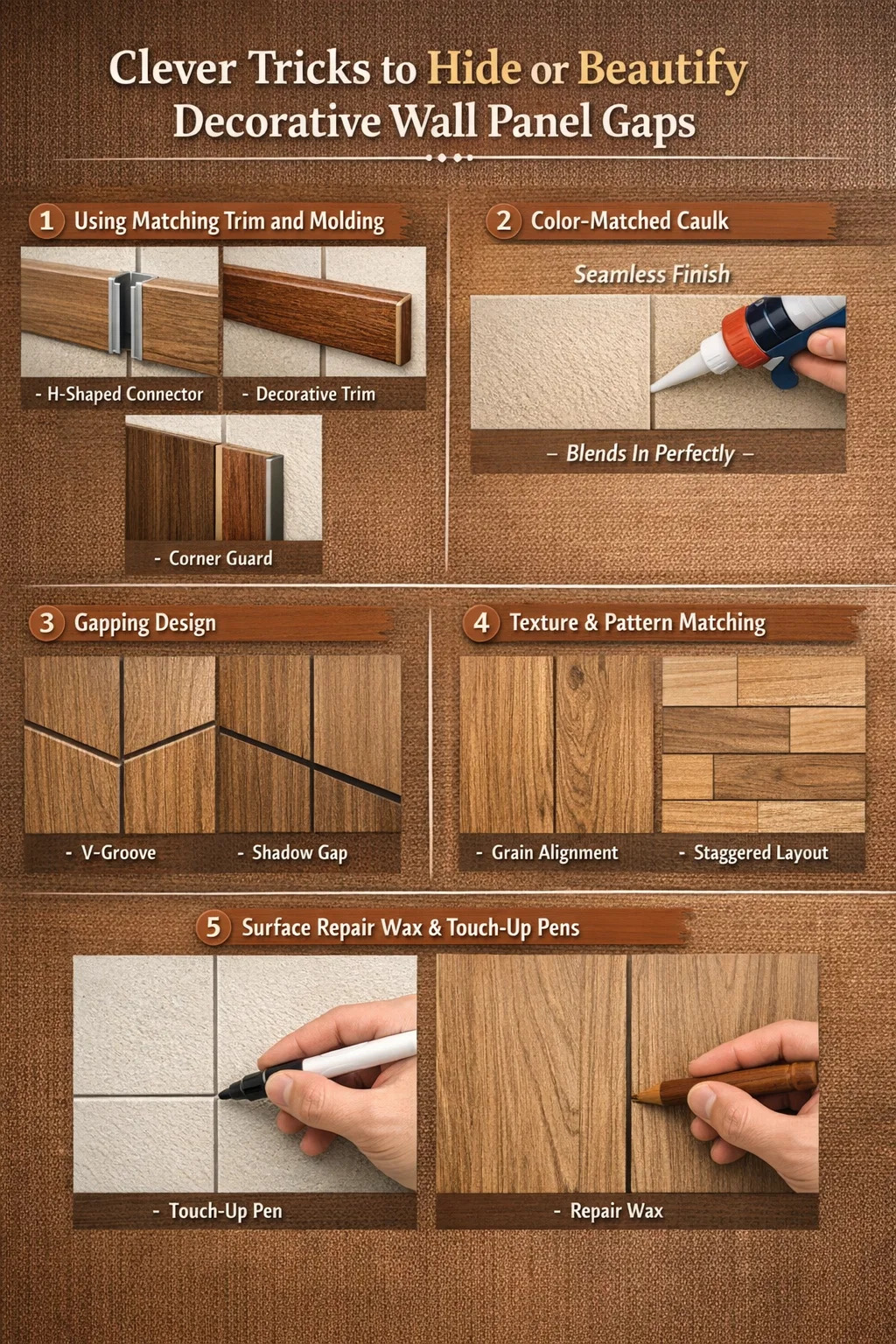
◆ Clever Tricks to Hide or Beautify Decorative Wall Panel Gaps
1. Using Matching Trim and Molding
This is the simplest and most reliable method, suitable for most decorative wall panels.
H-shaped or I-shaped connectors: Manufacturers usually provide special H-shaped or I-shaped connecting strips. Simply insert the two panels into the grooves of the strip, and the gap will be covered by the metal or plastic strip.
Decorative trim: Pressing a beautiful wooden or metal decorative strip over the gap not only covers the gap but also adds a frame-like effect to the decorative wall panels, giving them more depth.
Corner treatment: Gaps at the corners can be finished with special L-shaped corner guards for a clean and neat look.
2. Color-Matched Caulk
If you are aiming for a "seamless" visual effect, caulk is the best choice.
Color matching: Find a caulk that is almost the same color as your decorative wall panels. Squeeze the caulk into the gap and smooth it with a putty knife before it dries.
Eliminating traces: Once dry, the gaps will become very inconspicuous. This method is especially suitable for wall panels with fine textures and pure colors.
3. Cleverly Utilizing "Gapping" Design
Sometimes, instead of trying to hide the gaps, it's better to boldly display them and turn them into a design element.
V-groove design: Many decorative wall panels have beveled edges, which form a neat V-groove when put together. This subtle groove looks like intentionally designed lines and has a very modern feel.
Shadow gap: Deliberately leave a small, even gap (e.g., a few millimeters) between the two panels, and paint the inside with a dark color to create a "floating" visual effect, making the wall panels appear very three-dimensional.
4. Texture Alignment and Pattern Matching
For decorative wall panels with wood grain, stone patterns, or complex designs, the visibility of the seams depends on how accurately the patterns are aligned.
Grain Matching: During cutting and installation, try to ensure that the textures of adjacent panels align seamlessly. As long as the texture is continuous, the seams will be visually blended by the pattern, making them less noticeable.
Staggered Laying: Similar to laying tiles, use a "brick pattern" or random pattern to avoid long, continuous seams across the entire wall. This significantly reduces the visibility of the seams.
5. Surface Repair Wax or Touch-up Pens
For minor gaps or dents left during installation, repair tools can be used.
Color Touch-up Pens: These pens are like markers, but the colors are specifically formulated for decorative wall panels. A light application along the seam edges can cover the white edges or base color left after cutting the panels.
Repair Wax Sticks: These sticks are used like crayons to fill in small gaps, and then polished with a cloth for an effective invisible repair.

 ++86-18906857262 / ++86-13754347028
 No.49, Tunnan Industrial Zone, Daohui Street, Shangyu District, Shaoxing City, Zhejiang Province, China